
Inventory
Inventory that watches expiry for you.
PharmEasy tracks every batch of every product with its quantity and expiry date. First-Expire-First-Out (FEFO) is the default everywhere — at the till, in reports, on the dashboard — so the stock most at risk is always sold first. Most pharmacies see their expiry write-offs collapse in the first three months.
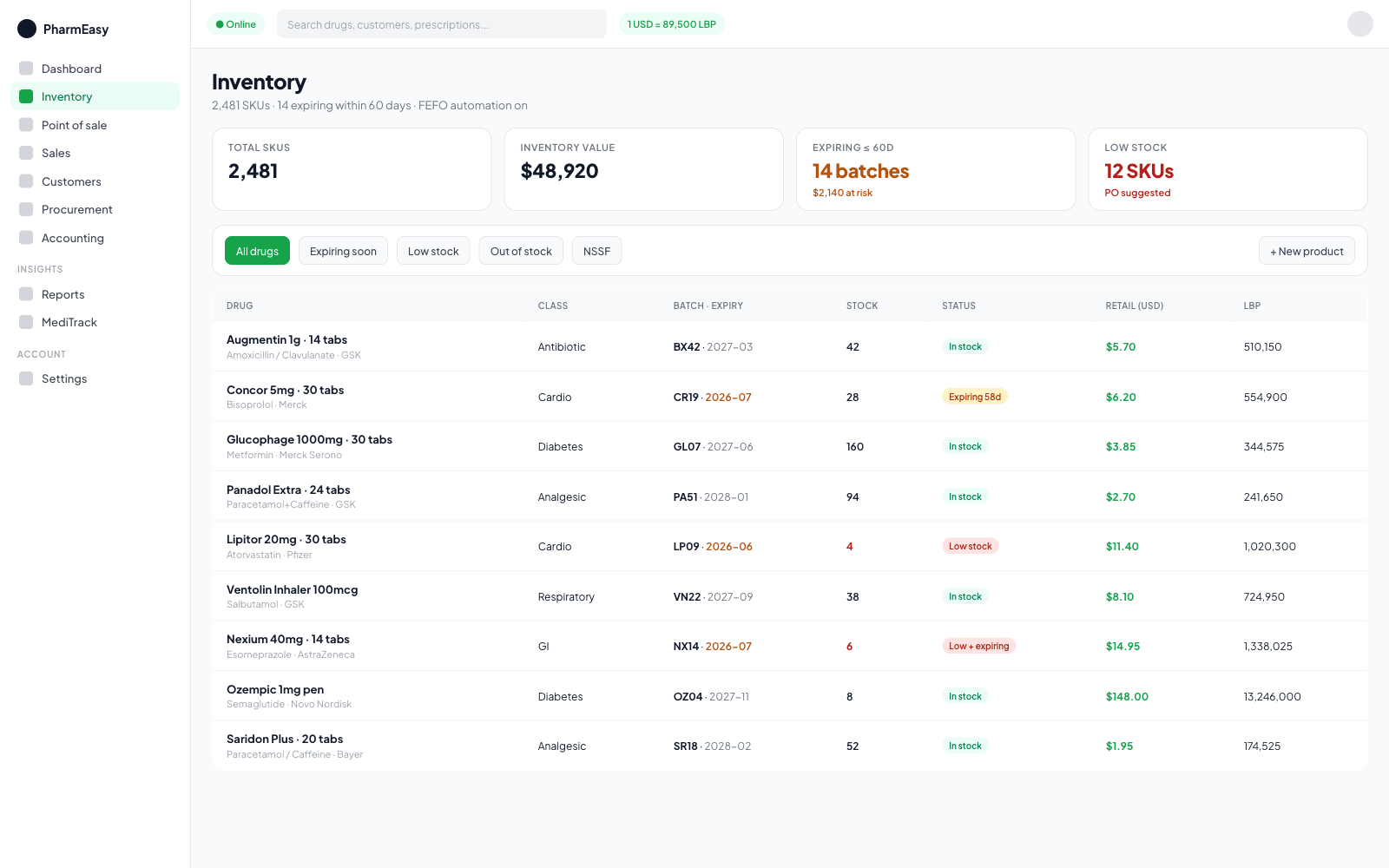
Batches, not just SKUs
Most pharmacy software tracks inventory at the SKU level — one count per drug. PharmEasy tracks it at the batch level: every batch has its own quantity, expiry date, and lot number, recorded at goods-receiving. That is the only way to honour FEFO accurately and the only way to be ready for MoPH inspections.
- Batch number + expiry date recorded at goods receiving
- Per-batch quantity tracking through dispensing and adjustments
- Audit trail of every batch movement (received, sold, returned, written off)
FEFO automation at the till
When a cashier rings a product that has multiple in-stock batches, PharmEasy automatically allocates to the batch with the earliest expiry first. The cashier sees which batch was used; if a clinical reason calls for a different batch, they can override with one keystroke. No more cashiers picking the back-of-shelf batch out of habit.
- Automatic FEFO batch allocation on every sale line
- Multi-batch splitting when one batch cannot cover the quantity
- Override audit log captures who overrode FEFO and why
Expiry warnings before write-off
The dashboard surfaces every batch within a configurable expiry window — typical defaults are 90 days, 60 days, and 30 days out — with the at-risk USD value. The owner can run a clearance promotion, return slow-moving batches to the distributor, or move stock between locations before it becomes a loss.
- Configurable expiry-warning thresholds per product class
- At-risk USD and LBP value surfaced on the dashboard
- Per-batch alert email or push notification (Pro plan)
Low-stock alerts that respect Lebanon supply
Lebanese pharmacies live with intermittent supply. Low-stock thresholds are configurable per product and account for typical lead times. The procurement module surfaces what to reorder and from which distributor, with historical pricing in both currencies.
Frequently asked
Common questions about inventory & fefo expiry.
- What is FEFO inventory management?
- FEFO (First-Expire-First-Out) is an inventory rotation method where the stock with the earliest expiry date is sold first, regardless of when each batch arrived at the pharmacy. It is the standard method in pharmacy operations because it minimises the risk of writing off expired products. PharmEasy applies FEFO automatically at the till — the cashier does not need to look up which batch to use.
- How is FEFO different from FIFO?
- FIFO (First-In-First-Out) sells the oldest stock first — the batch you received earliest. FEFO sells the soonest-to-expire batch first, which is sometimes the same batch but often not. In pharmacy, where shelf life varies sharply between products and even between manufacturers, FEFO is the safer choice. PharmEasy is FEFO-first by default; FIFO is available as an override but is rarely the right choice.
- How does data get into the batch-level inventory at migration?
- During installation we walk every shelf in the pharmacy and capture each batch with its expiry date, quantity, and lot number. For pharmacies migrating from SoftPharm or other Lebanese systems, batch data is often partial or missing — the migration team backfills it as part of the install fee. Once it is in PharmEasy, every goods receipt automatically maintains the batch record from then on.
Run your pharmacy with PharmEasy.
Demos are run by the founders. Tell us a bit about your pharmacy and we will get back within 24 hours.